Case Study: Optimizing a Hybridization LC-MS/MS Workflow for PMO And PPMO Bioanalysis
Phosphorodiamidate morpholino oligomers (PMOs) and peptide-conjugated PMOs (PPMOs) are emerging oligonucleotide therapeutic modalities that offer unique opportunities for targeted treatment approaches.
PMOs contain a charge-neutral morpholino backbone that provides increased nuclease stability, while PPMOs are designed by conjugating a cell-penetrating peptide to a PMO to enhance cellular uptake and tissue delivery.
Following administration of a PPMO therapeutic, both the intact PPMO and the corresponding unconjugated PMO species may need to be monitored, depending on the molecule’s biotransformation profile, stability, and mechanism of action. Simultaneous measurement of these analytes can provide a more complete understanding of pharmacokinetics (PK) and in vivo stability, but their different physicochemical properties can make simultaneous quantitation challenging.
Our team encountered this challenge while developing a bioanalytical method for a 21-mer PMO and its peptide-conjugated form. To selectively and sensitively quantify both analytes in rabbit plasma, we developed a hybridization LC-MS/MS workflow combining sequence-specific extraction with chromatographic separation and tandem mass spectrometry (MS). Presented at TIDES USA 2026, the study involved optimizing the hybridization extraction and LC-MS/MS conditions before qualifying the method for simultaneous PMO and PPMO quantitation.
In this case study, we share the approach we took, the challenges we encountered, and the findings that shaped the final workflow.
Developing a Hybridization LC-MS/MS Workflow for PMO and PPMO Bioanalysis
One of our first considerations was how to accommodate the distinct physicochemical properties of PMO and PPMO within the same analytical workflow. While PMOs are charge-neutral, conjugation of a peptide to form a PPMO can further alter charge, hydrophobicity, and overall molecular behavior.
This means that an analytical method designed for a conventional oligonucleotide may not transfer directly to PMO and PPMO bioanalysis.
Samples were hybridized with a biotinylated capture probe to selectively isolate the target oligonucleotides from rabbit plasma, and the resulting probe-analyte complexes were captured using streptavidin magnetic beads, which were washed to remove matrix interferences and thermally eluted prior to LC-MS/MS analysis.
Hybridization provided the sequence selectivity we needed for extraction. However, because PMO and PPMO share the same oligonucleotide sequence, the capture step alone could not distinguish between them. Chromatographic separation therefore became a critical part of the workflow.
Hybridization LC-MS/MS Workflow:
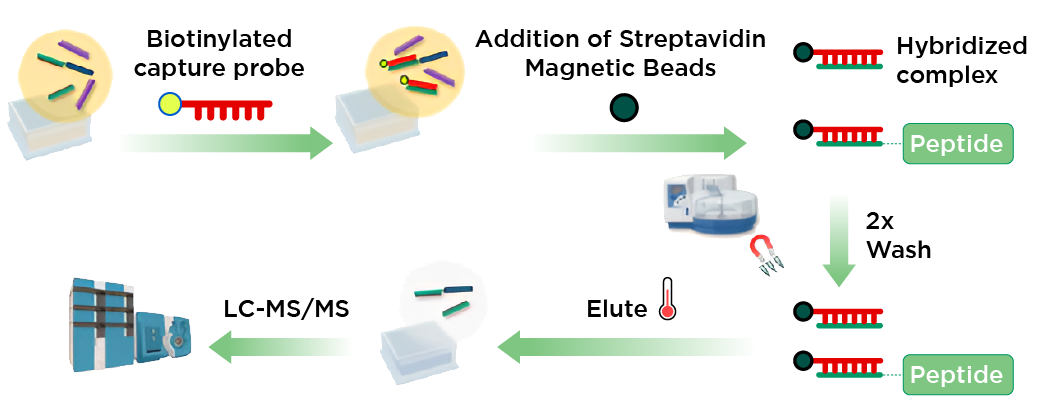
Hybridization LC-MS/MS Workflow ©Altasciences
OPTIMIZING HYBRIDIZATION EXTRACTION FOR PMO AND PPMO
We began optimization by evaluating one of the key variables affecting analyte recovery: capture probe chemistry.
DNA and peptide nucleic acid (PNA) capture probes were assessed across a range of NaCl concentrations. DNA probes produced substantially higher signal intensity for both PMO and PPMO across the conditions tested, indicating more efficient hybridization and recovery. PNA probes, by comparison, showed minimal response and were not suitable for this application.
We also found that moderate ionic strength provided the best overall performance, balancing efficient hybridization with reduced non-specific interactions. Based on these results, DNA probes were selected for the next stage of method development.
This is an important consideration when developing methods for new oligonucleotide modalities. Even when a hybridization-based approach is familiar, variables such as probe chemistry and capture conditions can have a significant effect on assay performance and need to be evaluated for the specific analyte.
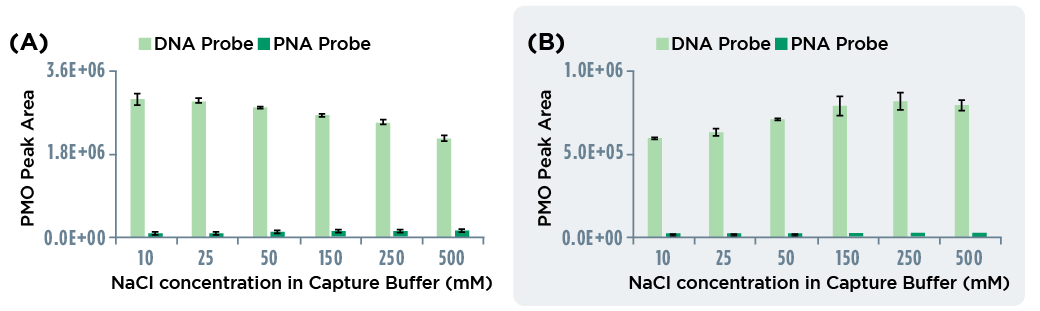
Comparison of DNA and PNA capture probes for hybridization extraction of PMO (A) and PPMO (B) ©Altasciences.
IMPROVING LC-MS/MS SENSITIVITY FOR PMO AND PPMO BIOANALYSIS
Sequence-specific hybridization provided selective enrichment of both PMO and PPMO from biological matrices. However, because the capture step recognizes the nucleotide sequence rather than the peptide conjugate, it cannot differentiate PMO from PPMO. The next challenge was therefore separating the two analytes while maintaining sufficient mass spectrometric sensitivity.
During method development, we evaluated trifluoroacetic acid (TFA) as a mobile phase additive to improve peak shape and achieve adequate chromatographic resolution between PMO and PPMO. But this improvement came with a trade-off: TFA also caused substantial ionization suppression, reducing the MS response for both PMO and PPMO.
To mitigate TFA-induced ionization suppression, we implemented a post-column addition of ammonium bicarbonate. As a result, the optimized conditions provided sharp chromatographic peaks, adequate resolution between PMO and PPMO, and sufficient sensitivity to support reliable simultaneous quantitation.
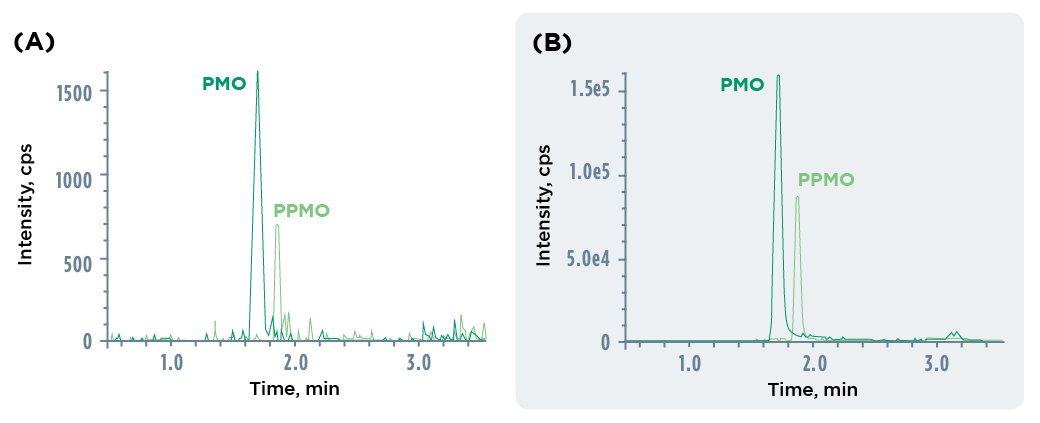
Post-column addition improves signal intensity by mitigating TFA-induced ion suppression: without (A) and with (B) post-column addition. ©Altasciences.
This substantially increased signal intensity while preserving chromatographic separation. The optimized conditions provided sharp chromatographic peaks, adequate resolution between PMO and PPMO, and sufficient sensitivity to support reliable simultaneous quantitation. The solution therefore came from balancing multiple parts of the workflow, rather than optimizing any one parameter in isolation. Extraction selectivity, chromatographic resolution, ionization, and MS response all needed to work together to provide reliable simultaneous quantitation.
HYBRIDIZATION LC-MS/MS METHOD QUALIFICATION IN RABBIT PLASMA
Once the extraction and LC-MS/MS conditions had been optimized, we qualified the method for the simultaneous quantitation of PMO and PPMO in rabbit plasma.
The assay calibration ranges were 2.00–1000 ng/mL for PMO and 5.00–2500 ng/mL for PPMO, with acceptable accuracy and precision across both ranges, including at the respective lower limits of quantitation.
We also evaluated matrix effects across six rabbit plasma lots, including hemolyzed plasma, with no meaningful lot-to-lot effects observed. Together, these results demonstrated that the optimized hybridization LC-MS/MS workflow supported selective and sensitive simultaneous quantitation of PMO and PPMO.
WHAT THESE FINDINGS MEAN FOR PMO AND PPMO DRUG DEVELOPMENT PROGRAMS
For sponsors developing PMO- and PPMO-based therapeutics, the key takeaway from this work is that bioanalytical strategy should reflect the behavior of the molecules being measured. Oligonucleotide therapeutics span a wide range of backbone chemistries, conjugates, charge states, and physicochemical properties, all of which can influence extraction efficiency, chromatographic behavior, ionization response, and overall assay performance.
Our findings demonstrate how sequence-specific hybridization extraction can be combined with optimized LC-MS/MS conditions to achieve selective and sensitive simultaneous quantitation of PMO and PPMO. More broadly, the work reinforces the importance of evaluating critical assay parameters early rather than assuming that an established oligonucleotide platform will transfer directly to a new modality.
There is no single set of analytical conditions that will apply to every PMO or PPMO. Tailoring method development to the specific molecule—and understanding where trade-offs between selectivity, separation, and sensitivity need to be made—can help reduce analytical risk, improve confidence in PK data, and provide a stronger foundation for subsequent development decisions.
Get in touch to learn more about Altasciences' bioanalytical capabilities, including LC-MS/MS and hybridization LC-MS/MS approaches for oligonucleotide therapeutics.
The findings in this article were first published in a scientific poster at TIDES USA 2026 by Ming-Luan Chen, Shaoxia Yu, Pallavi Lonkar, Jean-Nicholas Mess, and Kevork Mekhssia. Altasciences; Pepgen.
FAQ: LC-MS and PMO
What is LC-MS/MS and why is it widely used in bioanalysis?
LC-MS/MS combines liquid chromatography with tandem mass spectrometry to separate and quantify analytes in biological matrices. It is widely used because it offers high sensitivity, selectivity, and flexibility across a broad range of therapeutic modalities.
What are PMO and PPMO therapeutics?
PMOs and PPMOs are types of oligonucleotide therapeutics designed to target specific RNA sequences and influence how certain proteins are produced. PPMOs build on PMO technology by adding a peptide that can help improve cellular uptake and tissue delivery.
Why are PMO and PPMO modalities important in bioanalysis?
Bioanalytical methods are used to quantify PMO and PPMO exposure in biological samples and support pharmacokinetic and stability assessments. Because PMOs and PPMOs have distinct physicochemical properties, their analysis may require tailored approaches that provide sufficient selectivity, sensitivity, and reliable simultaneous quantitation.
Why is bioanalytical method optimization important during early drug development?
Reliable bioanalytical methods help generate accurate PK and dose-exposure data, support decision-making, reduce assay-related risks, and provide greater confidence in study outcomes throughout drug development.